
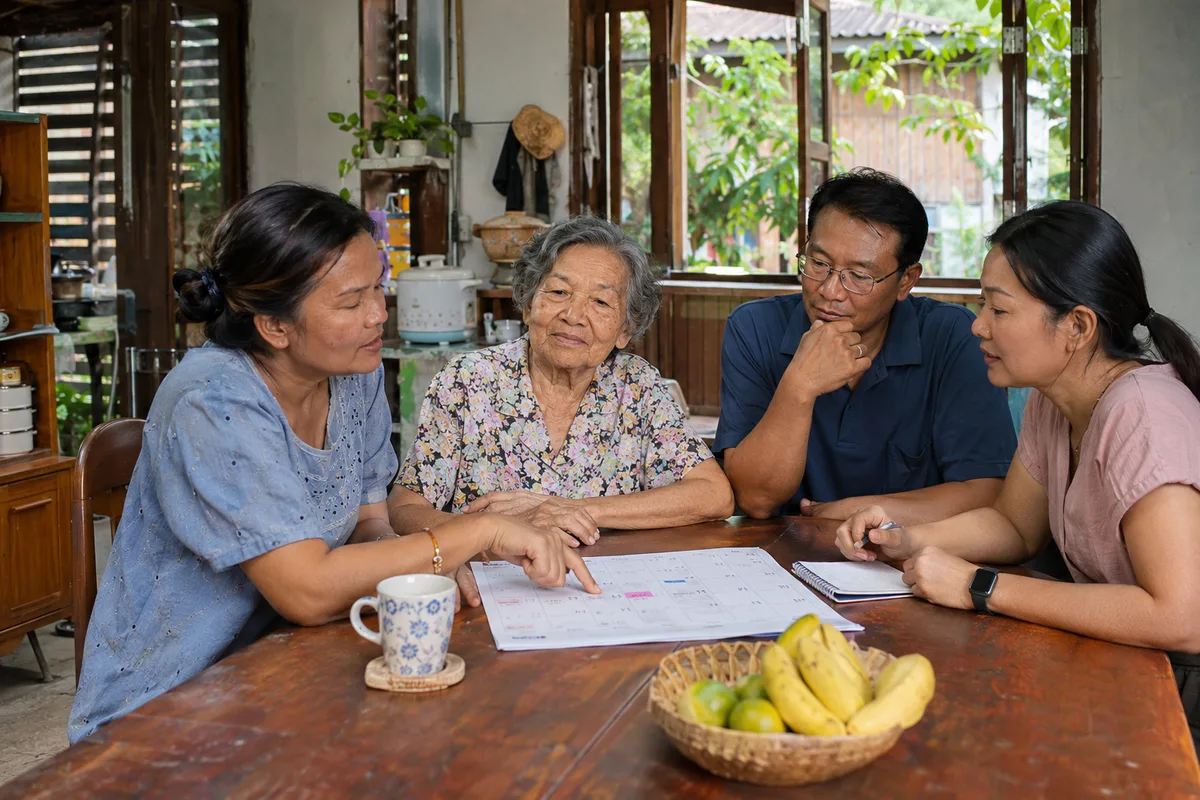
Illustrative scene created for this article.
When Mali asks her brother to help with their father, he reminds her that he transferred money yesterday. Both remember the conversation accurately. Mali needs someone to collect Dad from the clinic. Her brother believes the problem is the taxi fare. A meeting gives them a way to describe the same Tuesday in enough detail to discover what each has missed. It also gives Dad time to say what he would like to do with that day.
Ask your parent whom to invite
Talk with Dad before adding relatives to a group chat. Who does he want beside him? What would he like to decide himself? Which details about his health or money can be shared? If an hour feels tiring, invite him to join the part where his preferences matter most. He might like to record a voice message beforehand or ask someone he trusts to read out a note. If he prefers to speak, pick the time of day when he finds conversation easiest. A sibling who can only listen by phone can still hear the same wishes firsthand. [1] Family Caregiver Alliance
Give this meeting a question it can answer
“Which outings are still uncovered next month?” gives everyone something to prepare. Send the question and a finishing time ahead of the meeting. A shift worker can reply before going to sleep, and a daughter in another province can join for the ten minutes when her diary matters. If the group brings up inheritance, an old disagreement or a possible move next year, write it down for another conversation. Ask whether anything about the immediate arrangements truly depends on settling that question today. Often it is possible to book next Tuesday’s ride while a bigger decision waits. [1] Family Caregiver Alliance
Reconstruct an ordinary day
Ask the relative at home to describe yesterday, from the first phone call to the last errand. A clinic visit might involve confirming the date, ordering a car that Dad can get into, finding someone to watch his shop and keeping the parking receipt. Waiting at the clinic may take longer than driving there. Write one action per line. Leave space beside it for preparation, travel and follow-up. Someone offering an hour from work can then choose a job that fits, and the effort spent making the trip possible becomes visible to relatives who usually see only the return home.
Look for a time when one person needs to be in two places, such as collecting a document while collecting a child from school. Could the document be collected later? Write down what Dad still wants to do himself, too. He might enjoy packing his own hat and directing the driver to the right gate. If two relatives volunteer to make the same booking, one can keep the return trip free.
Ask what each household can reliably offer
A brother who cannot take weekdays off may be able to order supplies and chase missing deliveries. A night-shift worker might be able to drive most Wednesday afternoons. A parent of small children could cook an extra portion on Sundays. Invite people to name limits as well as offers. Calling during a factory shift may be impossible, or paying for a taxi every week may exceed a household’s budget. Leave a blank beside any job assigned in conversation to an absent cousin. Living near Dad does not tell the group whether that cousin has agreed to help. [2] Family Caregiver Alliance
A relative joining by phone may be able to take on a care task from another province, such as arranging an appointment and confirming it with the driver.
Give the driver a backup who knows when to step in
“Everyone helps with transport” leaves three people waiting for someone else to book the car. Try a sentence they can act on. Nid will call by Monday evening and send the pickup time. If the car is unavailable, she will call Nat, who can find another driver but cannot travel to the clinic. Decide what the person accompanying Dad needs to report afterwards. The date and practical arrangements for the return visit may be enough. Keep a private discussion between Dad and his clinician within the circle Dad has chosen.
Give costs their own conversation
Put the recurring expenses on the table, including taxi fares, parking and the cost of someone staying at home. Ask which expenses each household can take on. The person taking leave to drive may also lose income. Agree who can authorise a purchase, who keeps the receipt and when a relative who pays up front will be reimbursed. If the money belongs to Dad, involve him in deciding how it is spent. A simple record can help a sibling plan next month without having to ask the person doing the shopping to explain every receipt twice.
A Friday market stall changes the plan
Imagine that Aom’s father sells vegetables on Fridays and wants to return in time to close his stall. His usual driver has developed back pain. His son offers more taxi money, but Dad explains that he is worried about leaving the cash box unattended. Aom agrees to ask the clinic about available appointment days. Her brother arranges transport. Their niece agrees to mind the change with the neighbouring trader. Dad decides whom he wants helping at the stall. The family has identified a piece of work that a ride or a bank transfer alone could never cover.
Pause when the argument becomes about fairness
Invite someone who feels overlooked to describe one event. “I closed my shop for three Wednesday mornings” gives others something concrete to understand. Ask another person to repeat what they heard before explaining their own limits. Then ask what would ease the next Wednesday. Take a break if everyone starts rehearsing old grievances or speaking over Dad. A neutral person whom the family and Dad both trust can help people take turns if meetings repeatedly break down. Allow someone to reconsider an offer after checking a work roster. An honest limit gives the group time to fill the gap. [1] Family Caregiver Alliance
Send a note people can act on
A useful message says when Dad wants to leave, who booked the car, who takes the backup call and who watches the stall until noon. Ask each named person to acknowledge their part. Add a date for resolving anything left open. If Dad likes paper, put the arrangement in large print beside his calendar and keep sensitive information elsewhere. Read the note aloud to him if that is easier. Someone arriving for the first time should be able to tell from it when to come and whom to contact if the driver is late.
Review one real trip before promising the next ten
Ask Dad what he would repeat. Then ask each helper how the time and cost compared with their estimate. Perhaps the outbound trip was fine, but Dad was tired by the end of the wait and needed company on the journey home. Moving a helper from morning to afternoon could make a bigger difference than booking an earlier taxi. A date for reviewing the arrangement allows people to try a role without taking it on indefinitely. If a job remains uncovered, name it openly and discuss another relative or a local service Dad would be happy to use.